Showing posts with label Sid. Show all posts

Monday, June 2, 2014

The Enigma - Key West Cemetery, 2014

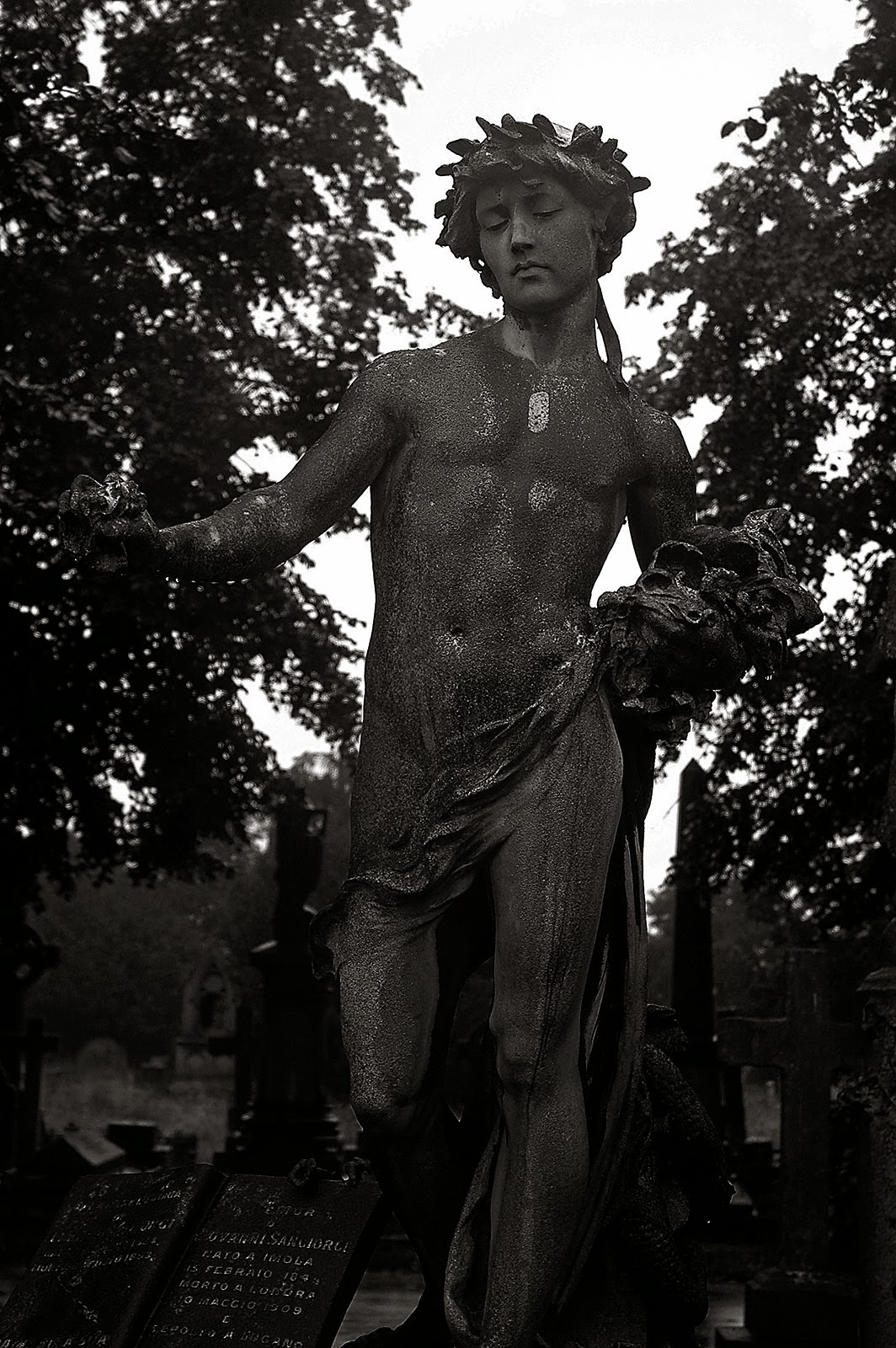
Memorial statuary tends to fall into basic groups:  angels, Christs, cherubs, the occasional portrait, perhaps a dove, and so on.  But during my visit to Key West Cemetery, there was one statue that fell into none of the standard categories.


How did this unexpected nude, with its unusual position and flattened features, come to be in the cemetery? It stands over the grave of Archibald John Sheldon Yates, 1911 - 1966, whose gravestone lies in the centre of his shattered tomb.


The statue's weatherworn face is almost expressionless, but its tilted head and closed eyes project a sort of ecstasy - or is it suffering?  In retrospect, I cannot say if the statue's hands are bound or not, but their position appears to be one of bondage.


I suspect that some research online would reveal the story behind this figure, but I decided not to investigate.  Some mysteries are more satisfying when left unsolved.
- Sid

Sunday, April 27, 2014

Key West Cemetery, 2014


 The Key West Cemetery is a fascinating location. Over time I've become a bit of a connoisseur of cemeteries, each of which has its own look and feel. 

First, let's get the obligatory photo out of the way. Key West is home to what may well be one of the most photographed monuments in the world.  It doesn't lend itself to artistic interpretation, so here it is, shot in what you might call an evidentiary style:  been there, done that.  (Although I didn't see t-shirts documenting this particular attraction anywhere on Duval Street.)


And, in the interests of being thorough, three feet higher on the same wall:


Key West has some raised crypts, which gives it some of the feel of the cemeteries in New Orleans, but there are far more standard ground-level graves than there were in New Orleans.  It is very obviously a frequently visited location (although in the first of my three visits I didn't see a soul, so to speak.)  

Something that sets the Key West Cemetery apart is the astonishing range of little statuettes and figurines that have been added to the graves.  I'll do a couple more posts showcasing this, there were just too many examples to reasonably put into a single post.


- Sid

Sunday, April 13, 2014

Variations on variations on a theme: Marie Laveau.

Colin has already posted some images of the resting place of Marie Laveau, the Voodoo Queen of New Orleans.  In this case, my take on the subject was more of a wide view, whereas he had chosen to go with closer framing.


Now, let's take a moment and talk about the unacknowledged participant in the process:  Photoshop.  I believe that Colin uses other pieces of software, but that's where I do my editing and cropping and so on.

Although I've done lots of image composition and special effects and retouching and so on with Photoshop, when it comes to my own photography I tend to use it pretty much the way I was taught to use a darkroom - I brighten, I darken, dodge and burn* selectively, change contrast and saturation, and that's about it. 


 I also make a decision about colour versus grey scale.  (It's interesting that black and white has survived the end of film as an artistic decision that one makes in a piece of software rather than a choice of film types - although, that being said, I think both Colin and I often plan for that choice when shooting the original images.)


One of the features of Photoshop that I almost NEVER use are the special effects filters:  Brush Strokes and Graphic Pen and Plastic Wrap and so on.  However, just for fun, I did the above image with a 50% overlay of Find Edges, which brought an additional level of grunge to the look of the monument - but, frankly,makes me feels like I'm trying too hard to find something that I didn't get in the original image.
 - Sid
 
* I recently had to explain to someone what dodging and burning was in terms of the icons for those tools in Photoshop, which shows a curled hand for burning, and a circular piece of material on a wire for dodging, which is how those actions were traditionally done in the darkroom.

Sunday, April 6, 2014

Variations on a theme II.

Colin suggested that we post images of common subjects from the Stirling Cemetery, and here's my somewhat belated response on the topic. 

To be honest, the two subjects he selected are both ones that I photographed but I can't really say that I did anything brilliant with either one. (I was far more interested in the nearby pyramidal Rock of Ages memorial.)


Regardless, here is my take on the Black Panther Angel and the Like-Minded Sisters.

Of the two, I'm least pleased with my shots of the Black Panther Angel - a description which inexplicably puzzled Colin.  Given that Colin is far more a child of the 60s than I am, I would think that the following pose would make the connection obvious.  In fact, it's an odd pose for an angel, when you think about it. And is it me or does she only have four fingers?


I do wonder how the Angel lost half her star, which seems a sad fate for an angel.


The Like-Minded Sisters offered a more interesting subject - virgins under glass, as it were.


I refer the curious reader to the plaque on the casement:


I'm intrigued as to the tale behind Margaret and Agnes, virgin martyrs of the ocean waves - or wave.  Why does Margaret take precedence in virginity and martyrdom?  Is it based on age?  Is "impearled" a bad aquatic pun or a typographical error?  How was their martyrdom achieved?  I assume it took place at the same time, and that the two figures with the angel represent the sisters in question, with the lamb at their feet as a symbol of innocence.  And, somewhat unusual for a memorial - what was their last name?

In this case (no pun intended), I can offer little in terms of variety from Colin's approach: putting statues under glass can limit a photographer's choices purely on the basis of reflection.


- Sid

Wednesday, March 19, 2014

Brompton Cemetery, 2011

As Colin has already mentioned, Brompton Cemetery in London is a wondrous location.  It is quite literally a necropolis, a city of the dead that sprawls over 39 acres and has seen over 200,000 burials.  I stumbled across Brompton Cemetery in 2011 while somewhat frantically trying to find the Doctor Who Experience for which I had purchased a ticket as part of the London portion of my fiftieth birthday trip to Europe.

I was instantly captivated by the prospect of photographing Brompton, but my time was running out and I was still lost in the pouring rain.  Reluctantly I turned my back and continued my hunt. 

I managed to find the Experience with ten minutes to spare, but when it was over I retraced my tracks to the cemetery and pulled out my camera. 

It was a horribly frustrating experience - never before have I spent so much time trying to capture the vision of a location with so little success, and the following shots are the best of a poor lot, in my opinion.  It is possible that I did a slightly better job when Colin and I visited London last year, but for now I'll start with these black and white images from 2011.


- Sid

P.S. the first image is the same melancholy figure that Colin posted in his earlier introduction to Brompton Cemetery.  Again, I think that the pictures that I took on my second visit do her more justice, although it's interesting to see that in the intervening years she added a garland of ivy to her ensemble.

Sunday, March 9, 2014

New Orleans, St. Louis Cemetery No. 1

I think that Cemetery No. 1 in New Orleans was the first time that I took graveyard photos.  Colin and I were down there on vacation, and when we heard about the cemeteries, we instantly knew that we had to go to one of the locations and take some pictures.

Cemetery No. 1 isn't safe - people have been shot there, tourists have been robbed, and although it would be a great place to take pictures at night, probably not a good idea.  There were a couple of armed guards wandering around in between the graves when we were there, and several people had warned us to be a little careful.

Regardless, it was just an amazing location.  New Orleans has a well deserved reputation - that unique combination of Southern lifestyle, Creole influence, voodoo, the decadence of the French Quarter - and I found that Cemetery No. 1 had a sort of surreal vibe. I think that the pictures I took ended up having some of that feel, a kind of Twilight Zone strangeness.


 - Sid

Saturday, March 1, 2014

Luss Parish Church Cemetery, Luss

The headstones and memorials at the Luss Parish Church were so overgrown and coloured by lichen that they might well have changed the name of the town to Moss.  


- Sid

Sunday, February 23, 2014

Monmartre Cemetery: Part 2 - La ville des décédées.

Unlike most cemeteries, the one at Monmartre in Paris is located below the current ground level.  As I mentioned in my previous post, initially I didn't know how to approach this subject.  However, after focusing in on the details in one section, I returned to street level to survey the cemetery for my next location.

Interestingly, from that angle the graves and tombs had an architectural look, as if I was viewing a city from above, and I ended up staying where I was and shooting on that basis - as if it were a city of the dead.


- Sid

P.S.  If someone reads this and says, "Hey, that's not really how you say 'City of the dead' in French, my apologies.  I will be happy to correct the title if someone can provide me with a proper translation.

Monmartre Cemetery: Part 1 - The Devil is in the Details.

I photographed the cemetery at Monmartre in Paris in the final stages of a three-week trip for my fiftieth birthday.  At that point, I was a little burned out after three weeks on the road, and a little stressed by five days of struggling to survive on my high school French in Paris, and as such I don't really feel that I did justice to my subject.

Unlike some of the other cemeteries that I'd photographed, Montmartre lacked that sense of decrepitude and decay that tends to interest me photographically.  As a result, I felt more than a little lost as I wandered the laneways between tombs.  However, little things began to catch my eye, details and decorations that had lost their perfection over time, and that was when I started to find it interesting.


The figure of the crucified Christ whose head starts the gallery above was an astonishing image. It's difficult to imagine how this statue would have looked before decades of verdigris and dirt had marked it; I suspect it would lack the drama that Time had provided.


When working on the images for this gallery, I did something that I've never tried before, and desaturated the background. It really didn't make any difference, the strength of the central figure made the background irrelevant. Nonetheless, here's the alternate version for the purposes of comparison.

 - Sid